
 27″ IMAC Flight Cases
 55″ + Screens
 65″ + Screens
 80″ + Screens
Meta title: Drawer Flight Case vs Cable Trunk: Which Survives a Tour?
Meta description: Drawer flight case or cable trunk? Compare access speed, capacity, weight and road wear, and find out which storage setup wins for cables, tools and loose kit on tour.
Slug: drawer-flight-case-vs-cable-trunk
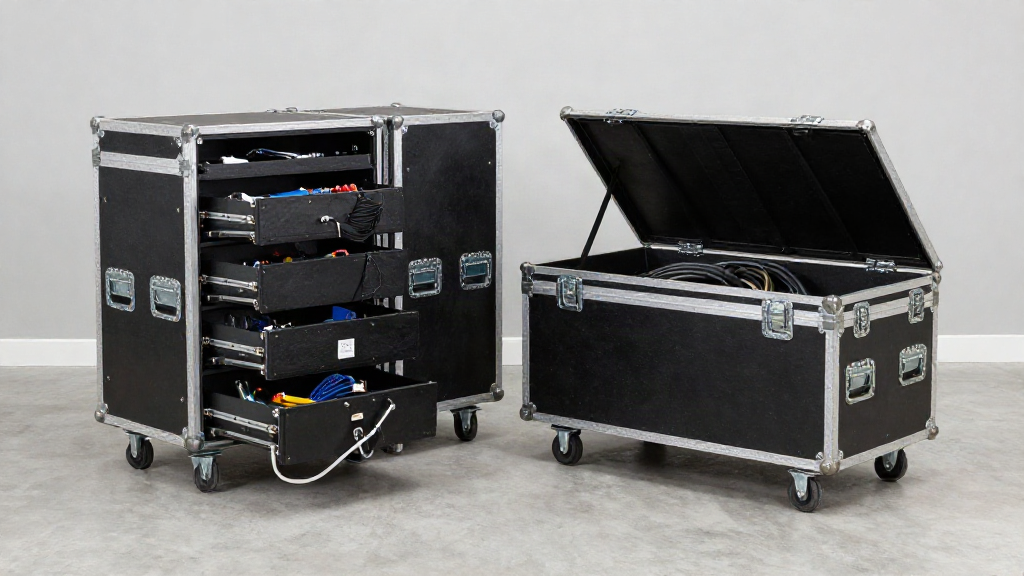
Every tour carries the same argument: where does the loose gear go? Cables, tools, adapters, tape, spare strings, gaff, drum keys. The two case types crews keep putting head to head are the drawer flight case and the cable trunk. Both are ATA-style road cases. Both roll. Both protect what is inside. They solve the same problem in completely different ways, and picking the wrong one costs you minutes every single day of a run.
Here is how the two compare on the things that actually matter once the truck is loaded.
What Each Case Actually Is
A drawer flight case is a road case built around sliding drawers. Instead of one open cavity, you get stacked compartments that pull out and let you see everything at once. The 3 Milk Crate Drawers in ATA Style Case is the simplest version of the idea, while the 4 Large Tub – Drawer 3/8″ Ply Heavy Duty ATA Case with wheels takes it further with four deep tubs for bulk storage. Larger productions often run a 4 Drawer Workstation, which adds a lid table so the case doubles as a work surface on site.
A cable trunk is the opposite philosophy. One big volume, one lid, maximum usable space. Our 22″ x 22″ Cable Trunk handles daily cable runs, and the 30″ Wide x 30″ Deep Cable Trunks in standard and extra-high versions carry serious volume for touring and broadcast crews. The 30×22 Trunk – Extra High (28″) adds height when you need depth rather than floor space.
So the drawer flight case organizes. The cable trunk stores.
Access Speed: Drawers Win on Paper, Trunks Win in Practice
Drawers are unbeatable when you know where things live. Pull, grab, close. No lifting, no digging through the top layer to find the one cable you need at 6pm before doors.
Trunks reward a different habit. If a trunk is packed by category – power on one side, signal on the other, spares in the middle – a crew that knows the layout can reach in and pull what it needs in seconds. The catch is discipline. A poorly packed trunk becomes a pit, and a pit costs you more time than any drawer setup ever will.
The honest answer: drawers win for known, repeatable access. Trunks win when the crew is experienced and the load changes night to night.
Capacity and Weight
Per square foot of truck floor, a cable trunk holds more. There is no drawer mechanism, no frames, no wasted clearance. A single extra-high trunk can swallow the loose cable and accessories that would take two drawer cases to match.
Drawers trade raw volume for structure, and that structure has weight. Sliding mechanisms, tubs and frames add mass, though every case in the range is built on 1/4″ or 3/8″ ply and rolls on heavy-duty dolly wheels, so you are pushing loaded cases rather than carrying them. For one or two person load-ins, a wheeled drawer case or trunk is the difference between a smooth strike and a long night.
Road Wear and Durability
Both types are ATA-style cases, built for air, road and sea transport, and both use the same plywood shells and hardware. The real durability question is not the shell but how the case is loaded and moved.
Drawers take more punishment because they move. Every slide is a wear point, and a drawer slammed shut under a full load stresses its runners. Look after the slides and a good drawer case runs for years.
Trunks have fewer moving parts. Their failure mode is different: overload them and the walls take the strain, especially if the case is lifted by the lid. Keep to sensible loads, use the wheels, and a cable trunk is close to indestructible.
When a Drawer Flight Case Wins
Choose drawers when:
- The same small items travel every night and the crew needs fast, predictable access.
- You want a bench. The 4 Drawer Workstation with lid table gives you storage and a working surface in one case.
- You are managing tools, spares or wardrobe and need visual inventory at a glance.
- Wrong items are expensive. If pulling the wrong cable costs you a soundcheck, closed drawers force you to look before you grab.
When a Cable Trunk Wins
Choose a trunk when:
- Volume matters more than order: long cable runs, truss accessories, power distro, loose kit.
- You need maximum capacity in a single footprint and have a crew that packs to a system.
- You are moving mixed gear where “everything loose” lives in one place.
- You want the simplest case to repair and maintain over a long tour.
The Setup Most Tours Actually Run
This is not really an either/or decision. The strongest configurations we see pair both: a drawer flight case for tools, adapters and everyday items, plus one or two cable trunks for bulk runs and spares. Drawers handle the gear you touch twelve times a day. Trunks handle the gear you touch once per load-in.
If you are buying for a single case budget, start with the trunk. It carries more and never gets in your way. If your problem is chaos at the tool level, start with drawers.
Next Steps
Every case in the range is built to the same standard: ATA-style construction in 1/4″ or 3/8″ ply, heavy-duty dolly wheels, and hands-on support from a working touring supplier. Tell us what you carry, how often you load, and whether you fly, and we will tell you which setup survives your tour – and ship it worldwide.
Better touring starts with the right case. Talk to AK Flight Cases about a drawer flight case, a cable trunk, or the combination that finally ends the loose-gear argument.
