
 27″ IMAC Flight Cases
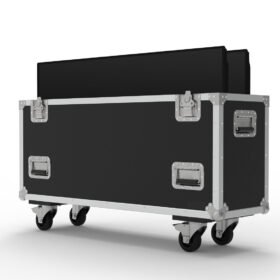 55″ + Screens
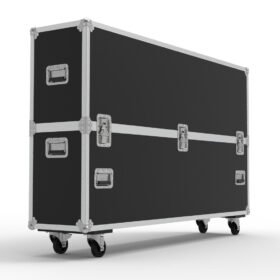 65″ + Screens
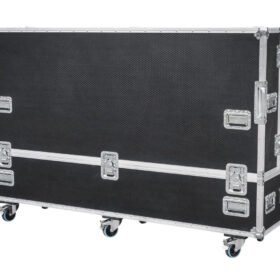 80″ + Screens
Meta title: Flight Case Basics: ATA Rating, Ply Grades & Wheels
Meta description: What ATA rating, 1/4″ vs 3/8″ ply, casters and butterfly latches actually mean on tour – plus a simple checklist for choosing your first flight case.
Slug: flight-case-basics-ata-rating-ply-grades-wheels
Flight Case Basics: ATA Rating, Ply Grades and Wheels Explained
If you are buying your first flight case, the spec sheet can read like a foreign language. ATA. 1/4″ ply. 3/8″ ply. Butterfly latches. Dolly wheels. Every one of those terms answers a simple question: what happens to your gear when the case leaves your hands and goes into someone else’s truck, someone else’s cargo hold, someone else’s hands.
This is a plain-spoken primer on the parts of a flight case that actually matter, and what each one means on the road.
What “ATA” really means
ATA stands for Air Transport Association. In practice, an ATA-style flight case is built to survive the way airlines and freight handlers treat cargo. That means a rigid shell, metal edging, recessed hardware and a closing system that does not pop open when a crate gets dropped.
The word ATA is not a certificate you hang on a wall. It is shorthand for a construction standard. When a case is described as ATA-approved, the point is that it was built to hold up under repeated air, road and sea transport – not a one-time move.
For touring professionals, this matters more than any single material choice. A venue load-in is a hundred small impacts. An ATA design spreads those impacts across the whole shell instead of concentrating them on one corner.
Ply grades: the shell that carries the load
The walls of most ATA cases are plywood, laminated and edged. The number that matters is the ply thickness.
1/4″ ply is the lighter option. It keeps the case manageable when you are lifting it in and out of a van by hand, and it is a strong fit for gear that is already internally protected – a controller in its own padded shell, a screen with internal foam, a cable run that only needs containment. A good example is the 1/4″ Ply Case w/Wheels – ID 30″ x 24″ x 8″, built for repeated touring transport without fighting you at every load-in.
3/8″ ply is the heavier duty option. More mass in the shell means more resistance to crushing, twisting and puncture. If the case is going into a belly hold with a stack of other cargo on top, or if it carries something heavy enough to flex a thinner wall, 3/8″ is the safer build. Trunks, wardrobe chests and large drawer units usually land here.
The rule of thumb: let the contents decide. Light, already-padded items travel fine in 1/4″. Heavy, exposed or high-value kit earns 3/8″.
Wheels, casters and dolly options
Wheels are the difference between a case you move and a case that moves you.
- Fixed or swivel casters let a loaded case roll through a venue instead of being dragged. Swivel casters up front make tight corners in a corridor possible.
- Dolly wheels are the larger, heavier-rated wheels used on big trunks and drawer units. They roll over door tracks, cable ramps and uneven dock plates that swallow small casters.
- Removable or braked wheels help when a case has to sit still on a slightly sloped stage or truck bed.
If the case will move more than twenty meters per day, wheels stop being an upgrade and become part of the design.
Latches, handles and the hardware list
Hardware is where cheap cases show themselves.
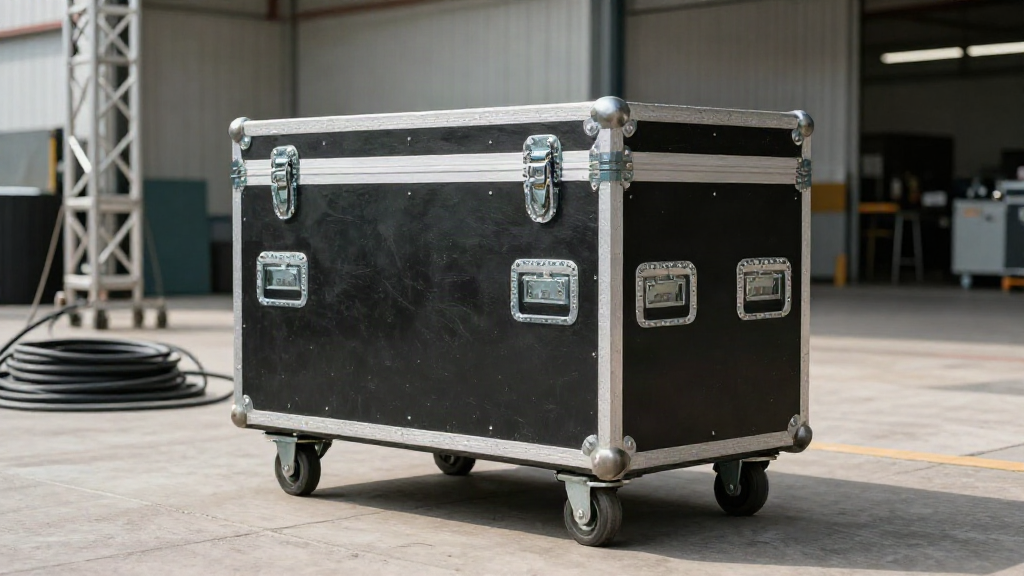
- Butterfly latches clamp the lid down evenly. Recessed ones sit flush so they do not snag on cargo nets or tear up a truck wall.
- Ball corners absorb impacts on the eight points most likely to hit first.
- Recessed handles keep the case stackable and stop handles from snapping off in transit.
- Aluminum edging ties the ply edges together, which is where water and impact usually get in.
None of these features show up in a photo the way a logo does. All of them decide whether the case is still serviceable after three tours.
Matching the case to the gear: a few common builds
Different loads ask for different cases, and the naming usually tells you which is which.
- A DJ flight case or DJ controller flight case is sized around a specific controller – the Numark NS6II Controller Flight Case is built for exactly one deck, so the device sits in its own cutout with no room to slide.
- A drum kit flight case or cymbal case travels with hardware and shells that need internal dividers, not just a big empty box.
- A drawer flight case or 4 large tub drawer unit turns a trunk into a mobile toolbox, so tools and cables stay sorted instead of living in a loose pile at the bottom.
- Trunks and cases in the larger sizes, like the 30×22 extra-high trunk or the 30″ x 30″ cable trunk, carry bulk cable, wardrobe and production kit that would otherwise travel unprotected.
If you are not sure which build fits, measure the gear, add foam clearance on every side, and let that number choose the case.
A simple checklist for your first flight case
- Measure the gear first, then add clearance for foam on all six sides.
- Choose ply thickness by weight and exposure, not by price alone.
- Decide how far the case moves per day. That answer sets your wheel spec.
- Check the hardware: recessed butterfly latches, ball corners, recessed handles, aluminum edging.
- Confirm the case is built to ATA-style standards for the transport you actually use.
- Plan for storage at rest, not just transit – a case that stacks well saves truck space.
The short version
ATA tells you the case is built for real transport. Ply thickness tells you how much abuse the shell takes before the contents do. Wheels and hardware tell you how the case behaves when a crew is tired and the load-in is running late.
Get those three right and your first flight case will outlast the gear inside it. Get them wrong and you will be buying the same case twice.
Browse AK Flight Cases ATA trunks and cases to match a build to your gear, or talk to the team about a custom case for equipment that does not fit a standard size.
